Showing posts with label skepticism. Show all posts

The Skeptic


The child was restless... he was not naughty, just curious and inquisitve. Fascinated by the world around him, he constantly asked his father, who was a very wise man, he thought. Soon the father reached the limits of his wisdom while the child went on with his fantasies of space travel and life in distant worlds, all made possible by the incredible and continuous advancement of science.

An avid reader, he quickly went through the family library and went on to his school's library. The librarian, who was the typical grumpy old woman, scolded him. "You cannot take home a new book every day and return it the next morning and still have time to do your homework" she said. The boy, no longer a child, just looked at her perplexed and left, with a new book under his arm.

As an adolescent he was already disenchanted with religion and wanted nothing to do with it even while attending a catholic school. Still a believer, though...

The boy discovered music. And the Beatles. 10 years after the original beatlemania, he learned every single song the Beatles had performed and that way, he finally finished learning the english his school had failed to teach him.

Reading in english, he discovered Asimov, Clarke, Heinlein, Van Vogt and Herbert. The universe would never be the same and the world would never seem so large anymore. And the good doctor taught him many wonderful things while at the same time, engineering school taught him physics and quantum mechanics. And he marveled at how the world was such a strange and fascinating place.

When finishing university, the young man had a brief affair with religion. In the middle of it he married and had children. And the enthusiasm for religion quickly died as the obligations of tending to a growing family needs and a demanding job kept his mind busy with many things other than God.

And one day he realized he didn't think of God anymore. And nothing had happened. Through his efforts he was still successful and happy, with a loving wife and two wonderful children who fulfilled all his emotional needs.

The man finally gave himself permission not to believe. And he was happier than ever. Liberated. A true skeptic.


Share on Facebook

It is not easy to fool a skeptic


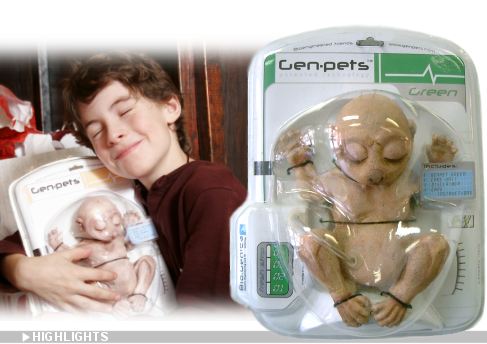
A few months ago I got an e-mail about this new product: genpets.

Below the usual mass of e-mail addresses for all the people this message had come from and forwarded to (why is it that people don't clean up their spam to protect their friends' privacy?) was this text from the (possible) first person to send the message (freely translated from said message):

"Just when we thought we had seen it all this news come in. One more company playing God and playing with lives at their will. PLEASE!!! DO NOT BUY THEM OR WE WILL BE ENCOURAGING THEIR MASS PRODUCTION... AND TAKING AWAY FROM OUR CHILDREN THE VALUE OF LIFE. Out there there are enough fully natural pets waiting to be adopted and capable of transmiting love and encouraging real emotions."

I don't know what's God got to do with all this or how buying an "artificial pet" takes from children the "value of life" (whatever that means) neither do I understand what is that issue with "real emotions". But the main issue here is that this lady (yes, it was a woman) took the ad and website at face value.

For me, getting this message was like reading in the newspaper that we had landed on Pluto... it does not make sense that we get to Pluto when we haven't even reached Mars, which is closer. Genetic engineering has not reached the point where a new species can be "created". Even though there is a website of the company that allegedly manufactures this pets, the whole thing seemd to me like a hoax; a very elaborate one, at that, but a hoax nonetheless. However, the long chain of forwards and the comments tells me that many people took this joke seriously.

Last week I remembered this incident and I googled "genpets". And it was not really a hoax. Everything relates to an artistic creation. It turns out that genpets are a creation of canadian artist Adam Brandejs. Although Mr. Brandejs indicates in his website that he is certainly concerned about the direction genetic engineering might take, he is also clear to point out that genpets are painted silicon sculptures, with electronic circuitry added that mimic breathing and movement.

This e-mail came in my inbox on December 1st, 2008 and at that time the genpets issue was completely debunked. The New York Times made a mention about them on June 24th, 2006 with a link to the "Museum of Hoaxes".

So... artwork or hoax, the truth is that genpets do not exist as anything else than an anymated sculpture. The reaction they caused reminds me of the mass panic caused by Orson Welles' radio broadcast of "The war of the worlds" in the 30s. Even though several times during the broadcast an announcement was made indicating that the transmission was only a play, many people were really convinced that a martian invasion was in progress. More recently, the famous crop circles have feed the fantasy of many UFO aficionados, in spite of the fact that in several instances, the authors of the circles have come forward and demonstrated the techniques used to fool the town while they were sleeping.

When people wants to believe nonsense and quit thinking and analyzing it is imposible to reason with them. Doubt does not represent anything else than the process of thinking and weighing the evidence that is presented. As Carl Sagan used to say "Extraordinary claims require extraordinary evidence". An e-mail message does not qualify as extraordinary evidence.

Nor does a professionaly developed website.


Note: this is a first! This post is being published today in english AND spanish in both my blogs, www.thechapinskeptic.info and www.elchapinesceptico.info. Hopefully there will be more simultaneous postings!

Susie Neunmalklug explains evolution

One of my Facebook friends posted this wonderful video. I am looking for more videos of this adorable little girl - her name Neunmalklug means nine times smart and she says it's not an exaggeration! I agree! Enjoy!


It is hard to be a skeptic


For 40-something years, I lived in the clutches of religion and supersticion. Some of the members of my family are extremely religious/supersticious and I was under that influence; for instance, I would not walk under a ladder or between a light pole and its tensioning wire because the ladder, wall and floor or the pole, floor and wire form a triangle... and you are not supposed to walk through a triangle, it somehow "distorts" your aura or something. I actually felt my aura "around me" and would feel extremely uneasy if I accidentally walked through any such triangle.

But the worst part of all was THE BOOK: dog-eared, stained, its pages almost loose, we had read it over and over. THE BOOK was "Self-Mastery and Fate With the Cycles of Life", one of the essential books of the rosicrucian's library. This book was written by H. Spencer Lewis, ostensibly the founder of the Rosicrucian order in San Jose, CA, and our family lived by it.

Very succintly, THE BOOK states that there are several time cycles in our lives: daily, yearly and an overarching one that goes in seven year intervals over your whole life. For instance, in the daily cycle there are seven periods in the day, each one aproximately 3 hours and 26 minutes (frack, I forget so many things and not this one!); the first one starts at midnight and lasts until 3:26 am; second one ending at 6:52, etc. These seven periods, each identified with a letter from A to G would alternate during the week, so that, for instance, Monday morning it would be E (6:52 to 10:17 am) and Tuesday, E would be at night (from 8:34 pm to midnight) and so on. (Again, I forget many things but those seem to be etched in my memory). The yearly cycle had 42 days and started on your birthday... I never really got around to the life-cycle, I think it was seven years long. So complicated.

All these timeframes had definite properties and there were things you should not do and things that were bound to be successful if started at the right time.

We lived our lives by this schedule. I got marrried in April (it was difficult to figure out the right month, what with my girlfriend and I having different yearly cycles since we did not share the same birthday) and on a Saturday evening (because it was B, a good time to get married - don't do it on E!). I tried to schedule my customer appointments according to these rules and it was a nightmare.

A good example of confirmation bias. Now that I look back on the whole thing I can remember things that went bad because they were started "at a bad time" as we used to say but so many things we tried to get well done and we did them at "a good time" never came to fruition. Of course, I remember the bad ones and not the good ones that never happened.

I got accepted into the rosicrucian order. I was told it was an accomplishment as I had been "spiritually" examined and found worthy.

I also got into the Self Realization Fellowship. I still have my credential somewhere.

This was part of the baggage that I got rid of when I convinced myself (or rather, gave myself permission) to stop believing in the supernatural. And this is one of the reasons why I say becoming an agnostic has been such a liberating experience. Not only am I guilt free (I am only human after all) but I am also freer with my time... now I have time to do many things at any moment I please.

Anyway, it is hard to be skeptic. It was difficult to convince myself that it was OK to meet people on Friday evening or Sunday afternoon. It was so difficult to stop my "aura" from tangling on those damn light poles! It took me a while and I may still not be "baggage free" as I sometimes catch myself exclaiming the G word or wondering if I should get out of the sidewalk to avoid that triangular configuration ahead.

But... practice makes perfect, they say. And I am happier now than I ever was before. Being a skeptic is hard but is worth it. Try it.


Skeptics should not be dogmatic

I have been listening to this wonderful Podcast "Escape Pod" (www.escapepod.org) which features a short science fiction story every week or so. They also have "flash" episodes which are even shorter stories, typically 5 to 7 minutes in length. It is a must listen for us, Sci-Fi geek/trekkies/fans.

One of the latest "flash" episodes, "Standards" by the (recently) late Richard K. Lyon gives us skeptics a tongue-in-cheek lesson in healthy skepticism. I suggest you listen to the episode but, without spoiling the fun, it deals with rejection of a scientific paper due to its implausibility even though the author is out there (and can be seen through the windows) demonstrating the very facts that the paper is about!

To listen to this short story is, as I mentioned, hilarious, but it brings home a very serious lesson: We, as skeptics, shoud not be dogmatic and must keep an open mind. Everything may be possible and we should, at least, examine the evidence before declaring a fraud. But we cannot just deny what we think is impossible adopting this very dogmatic posture we so strongly criticize in the fundies (as regards to religion) and the Stanton Friedmans (as regards to UFOs) and so on and so forth.

Skepticism means applying critical thinking to the evidence and weighing the pros and cons in order to reach a conclusion. Skeptics have to be inquisitive, curious and open-minded. Applying the scientific method is the way to the truth for a real skeptic and evidence (or lack of it) will determine whether a given phenomenom exists or not.

Skepticism is not disbelief. In reality, skepticism is not related to belief. The concept of belief implies acceptance of facts based on faith and faith has no place in the scientific method. Acceptance of facts, basis the evidence, is what substitutes belief for a skeptic. And this acceptance (or lack of it) will be subject to change as new evidence surfaces.

And this is the whole point of this posting. A dogmatic posture is not amenable to change; by definition it is fixed and cannot be changed. And a true skeptic will always be willing to change his/her mind as long as the evidence is there.

A fallacious appeal to authority

Our esteemed James Randi is said to always answer when someone introduces himself as an skeptic "I doubt that". I was reminded of that answer a couple of days ago when Facebook indicated the birthday of a new skeptic friend, who writes an interesting blog, in spanish. I wrote on his wall saying "Although I doubt it is your birthday, given the lack of evidence (I haven't seen your birth certificate) congratulations are not wasted so happy birthday!".

I didn't really expect a direct reply but he wrote back thanking me and asking me to forgo evidence and accept his falacious authority.

It was good and clean fun between skeptics but it illustrates what critical thinking is. Why should I believe it was Antonio's birthday? Because he says so? Granted, you might say that the biggest authority on all things Antonio is himself. However, people have been known to lie about their birthday and it really does not prove that such and such a day is my birthday just because I say so. (Especially if I am proven to celebrate my birthday more than once a year or on different dates every year).

This is the "appeal to authority" fallacy - just because someone says it, it does not mean it is true. There most be independent proof or corroboration.Especially when the person stating the fact is talking about something outside of their normal field of expertise - being an authority in comedy or nudism (Jenny McCarthy?) does not make you an expert on public health (vaccination and autism?)

So, don't believe everything you hear and say. Even if it is in the Bible, it does not mean it is true because it is written in the Bible. (Hear that Corny?) There must be a way to independently prove the point or we will be no better than those who believe vaccination is bad because Jenny McCarthy says so.

And everyone is always trying to have us believe claims basis an appeal to authority - just watch informmercials or Larry King Live and have fun debunking all those claims!

Happy new year to all!

Am I doing the Lord's work? or the Law of Unintended Consequences

The other day, D.J. Grothe, who evidently was spending a nice vacation with his beau, Thomas, in Mexico, posted an interesting tale of trying to do good and ending up with a big mess - a nice example of the Law of Unintended Consequences. For those not having access to D.J.'s Facebook, he and Thomas tried to feed some dogs and ended up causing a horrible dogfight, where one of the canines was probably killed by the others over the food that was offered.

Not in the same vein but also an example of unintended consequences, I got a nice e-mail from one of my readers/friends just yesterday.

My friend tells me that my blog as well as the links posted in it have helped him sort out his doubts and beliefs and now, as a rational christian, he is more secure of his faith in God. He says he has run the full gamut from believer to agnostic and is now safe and happy on his christian belief.

Well, I am puzzled but, truthfully, very happy for my friend.

As I have matured as a skeptic and agnostic, I have learned not to pick fights over religion or belief. I am "embedded" in a very conservative, catholic family and it is to my advantage not to get into arguments one way or another. If anything, seeing my (mostly political) family attend their various religious rituals and functions has pushed me further into agnosticism and I flirt with atheism all the time but I don't quarrel with their beliefs.

In fact, as I have mentioned before, I don't have a problem with people being religious. Organized religion tends to piss me off but people attending religious services and having their particular sets of beliefs, well, you can chalk that one up to freedom of speech, which I am 100% for.

And having read Dawkins and Harris, I have consciously decided not to be a militant atheist.

My initial purpose in writing this blog was to try and organize my ideas and philosophy into one coherent body. All the crazy things spinning in my head had to be given some kind of structure and the blog has helped me do that. In fact, going back over the initial postings, I see how my perspective has changed.

I continue to have fun with pastafarianism and will go on making fun of mormon's underwear or catholicism ritual cannibalism, not forgetting Corny's absolutely idiotic rantings. But I have come to feel secure in my ideas and content with other's beliefs... as long as they don't try to infringe on my personal space.

So, again, I was puzzled by my friend's e-mails but very happy that I was able to help. There is no doubt in my mind that the pursuit of happiness is one noble goal and part of that happiness is being secure and safe in your beliefs. If my writings help one way or another, well then, the golden rule is in action! And friends are always a blessing, however you want to interpret the word.

Thanks Ed!

Why skeptics like science fiction?


I have been following the skeptical movement for about two years now and I feel very identified with it because I have always been a skeptic at heart. And I feel more and more a part of this way of thinking when I realize that my passion for science fiction is shared with so many of my skeptical colleagues.

Maybe skeptics like science fiction because many of the best and best known SF writers of the 20th century were also skeptics. Arthur C. Clark lets readers clearly see his agnosticism/atheism; Isaac Asimov defends science and the scientific outlook in both his fiction and non-fiction writings; he was the original skeptic. And you can feel the skepticism in Heinlein's and Van Vogt's work. While you are at it, don't forget Gene Roddenberry and his Opus Magnum, Star Trek.
So, many good SF writers were (or probably were) skeptics. But what about our own mindset when we read (or watch) science fiction? Interestingly, us SF fans classify these works of art into "good SF" and "bad SF". How come? Most SF requires some suspension of disbelief in order to be enjoyed. Yeah, yeah, Dr. Krauss, I understand that beaming someone using a Star-Trek-type transporter would require so much information storage as to make it unpractical... but watching the special effects of Captain Kirk being "beamed up" and "down" does get us thinking how good a change to our daily conmute that would be and wouldn't it be good to have one of those at home. On the whole, Star Trek is regarded as good science fiction, warp drive non-withstanding. On the other hand I personally consider Star Wars a very low grade SF work... although many of my skeptically minded friends like the movies. What is the difference?

For me at least, the difference is that, while Star Trek at least tries to base some of the stories on some kind of science, Star Wars does not. When Captain Janeway asks for a "tachion beam", we already know that time disturbances are somehow linked to these "tachions" which, maybe, will now be discovered by the LHC. But "the Force" is so "mystical" and "religious" that I am personally turned off by it. It is like the Matrix - they do things that are impossible, only you know that "in the Matrix" they can be explained by manipulation of the "reality-producing" algorithms while there is no good explanation of how "the Force" works short of being a deist and considering a mysterious spiritual bonding of every atom of the universe... a concept I really shy away from.
So that most be the reason why Asimov and Clarke are considered among the top SF writers of the last century - two authors who consistently used good science and reasonable extrapolations of current knowledge throughout their stories, while some other writers (and I don't read them, so I don't want to name them) might best be classified as fantasy rather than SF authors.

And there is the "in-between" category. For instance, I am currently listening to J. C. Hutchins "7th. Son" trilogy. J.C.'s story has a wonderful flow that really grabs you and forces you to listen forsaking TV, sleep, sex and meals... well, maybe only TV. But I find that the need of suspension of disbelief is, at times, a little too much. For instance, J.C. postulates the existence of the mysterious "Aurora" aircraft and then narrates that it takes an Aurora 20 minutes from Virginia to the middle of Texas. OK, I think, maybe fly over Virginia and into Texas in 20 minutes... but landings and take-offs would easily consume an additional 10 minutes each considering the extreme heights at which such an aircraft would have to operate. And then you have the refueling problem (no refuelings occur...) and the Auroras, in the novel, seem to be kind of a flying 4X4, able to take off and land in almost any strip. It really strains my skepticism until I remind myself that "7th. Son" is a thriller more than a SF novel.

Maybe that is the reason I, as a skeptic, like SF. It flexes my critical thinking muscles and forces me to look beyond and try to see these things really happening... are they at all possible? If most of them are, in light of our current knowledge and a reasonable extrapolation into the future, then you are reading good SF.
J.C. Hutchins novel is available at Podiobooks.com. While you are there, be sure to check Mur Lafferty's excellent "Playing for keeps", which is now also in print and available at Amazon.com. I highly recommend both even if they are not all that "believable" but they are definitely enjoyable. Image above was found in this excellent blog, Trevize's computer.

Skepticism - is it global?


Browsing through the fora* of the Skeptics Guide to the Universe, I found someone is using a Frappr map of the SGU listeners, which I am showing above. Interestingly, most of the listeners are bunched together in North America and not surprisingly, most of them in the U.S. A couple show up in Mexico and south of there, I seem to be the only one! There are other bunches in Europe and elsewhere.

Arguably, the SGU is one of the most influential podcasts on skepticism and there are tens of thousands of downloads every week. It is in english, which should help people understand it. However, maybe because of iTunes' preference for the US and other first world countries, it is not being widely listened outside of North America.

So I began to wonder if skepticism is a regional phenomenom, in North America and some english speaking countries. It would make sense that in Latin America, with the historical influence of the Catholic Church and, now, the rising influence of the protestant religions, skeptics have not found a foothold as yet. Clearly, we have to do something.

There are only a few skeptic societies in LA. There is one in Colombia and apparently there is one in Costa Rica. I haven't found others and I think we should find and contact these fellow free thinkers in order to make the movement grow.

So, any fellow latin american skeptics, leave your comments. Contact me. Let us get together so that we can promote the advancement of science, education and critical thinking. Our countries are in bad need of educated people.

*Footnote: Fora is the plural for forum. Forum-s is not correct in latin. Sorry about that.

Is the Bible the Good Book?

Today I was trying to get up to date with one of my favorite podcasts, Skepticality. I was listening to episode 67, where Swoopy interviews Michael Adelson. From the show's very notes "Mr. Adelson had the good fortune to study with the late Rabbi Sherwin Wine. Rabbi Wine founded Humanistic Judaism, a secular movement which provides atheistic and agnostic Jews around the world with a means for organization, mobilization, and a sense of community."

I found the interview very interesting especially because Mr. Adelson speaks about what Humanistic Judaism means and how they treat the Tora and the Bible. They regard the Tora, for instance, with the utmost respect and admiration, recognizing the cultural significance it holds for Jews. However, they don't lose sight of the fact that the Tora is a book, meaning that they feel free to agree with parts of it, admire parts of it and reject the parts that do not seem good.

These words resonated with me. I feel the same about the Bible. There are parts that are nice, parts that are admirable and some that are, well, not good. (How about Lot giving his young daughters away to an angry mob to be ravished? is that good and moral behaviour?) And one of the wonderful things I have experienced in the last year or so as an agnostic is the freedom to feel and judge these things in their proper, humanistic and historical context. Yes, some of the 10 commandments are good rules for social behaviour. But as Reggie Finley (the Infidel Guy) says, the commandment about not lusting for your neighbor's wife is just not fair to our human nature. I may not be able to avoid lusting for my neighbor's wife, teacher, colleague, friend, whoever, if I see her and I find her desirable. That is only human and we should not punish ourselves for that. (Now, acting on that lust is a completely different thing altogether but that is neither here nor now.)

There is no denying the large influence of Christianity and the Bible in our western civilization, as I have said before. We must acknowledge it and embrace it. It is here and it is part of our way of life and values, even for skeptics, agnostics and atheists. But the Bible is a book, written by humans, with all the errors and inconsistencies that come with human nature. Some of it is fiction, some romance, some poetry and some symbolic, almost none of it is a historical account.

As free thinkers, it is our duty to let people know that they can also embrace the freedom of being religion-free. I do not advocate Richard Dawkin's , Christopher Hitchens' or even Sam Harris' activism but I do believe everyone has an opinion to voice and defend. And ideas to get respect for while respecting others' own ideas.

Name change

As of today, I am changing my blog's name to thechapinskeptic. I have reserved the domain name www.thechapinskeptic.info and the forwarding will be ready very soon.

This reflects my intention to pursue more skeptical issues and my desire to correspond with a larger audience of skeptics.

I will try to let everyone I know has read my blog know that the address has changed.

Astrology as a consequence of antropocentric thinking


Last evening, we were laughing and discussing CBS' new show, The Big Bang Theory. I believe Sheldon's retort to Penny about her being a virgo (or whatever sign she indicated) is going to become a classic. She says (quote) "I am a virgo, which probably tells you more about me than you need to know" and he responds "yes, it tells me that you are part of a group of deluded people who think that the position of arbitrary sets of constellations in the sky, relative to the sun at the moment of their birth has influence on their life events" (or something like that). Of course, Penny being blond, she doesn't understand and Leonard saves the moment by saying "we thought you were a water sign".

Jokes aside, this exchange shows the lack of intellectual depth of many current adepts to astrology. And it got me thinking that the reason some people may have thought that the stars had any bearing or effect on their destiny was the thinking (wrong, of course) that the whole universe was created for the benefit of man. Thank religion for that.

This antropocentric view of the world is no longer sustainable in view of our current knowledge of the universe. How can we justify being we so important the whole firmament will align itself this way or that for our benefit?

I will agree that this carachterization I am making of astrology is a reductio ad absurdum. But isn't the whole deal an absurdity?

Is religion born of man's fear of death?


It has been about 40 days of my father's death and I have missed him every single one. In my view of the world, my father's existence has ended; he is gone forever and I will never see him again. That neither makes the pain of my loss worse or unbearable for me; death is a natural part of life and is what makes life so precious and valuable. Nor would christianity's promise of eternal life make it easier. I still would not get to talk to him on the phone or hug him when I visit.

I was thinking about this last night at New Year's Eve mass. (I continue to go to mass for my wife's sake and because I enjoy the community interaction). Everytime I hear priests and preachers talk, they mention eternal life and the bliss of enjoying heaven and it seems to me that men are driven to believe in God simply because they are afraid of dying.

This fear of dying coupled with the usual promise of "eternal life" that religions offer, drives people to believe in christianity, judaism, islamism, budism, whatever. The hope of trascending our short stay in this world plus the promise of a better life if you behave, especially if your current life is not as nice as you would like, is a powerful magnet to faith.

And this magnet may have been one of the reasons for christianity's success against competing creeds, way back then. At the beginning of christianity, many religions offered eternal life but price of admission was steep and usually reserved for the rich. Then come these christians saying that Jesus offers eternal life for everyone in exchange for just belief. It must have been very tempting compared to what the competition offered - pay and eternal life or believe in Christ and eternal life. The choice is obvious. Then all others followed suit. Eternal life is cheap now, even if your church requires tithing. But then, churches now offer you wealth and health in exchange for your monthly dues and the whole thing seems only fair.

I had a "near death" experience a couple of years ago. I choked and lost conciousness for a few seconds. It was a very disconcerting experience to regain the use of my senses and wonder "where am I and who am I?". But after that wore off, I realized I had no memory of what had happened. I was walking and coughing one moment and the next I was looking at my wife's worried face. But after that, I reflected on one very important thing: I didn't feel anything! I could have died and never notice. Death would not have been painful and it would have been very quick.

I agree that there most be very painful ways to die. But the moment of death itself is like falling asleep at night. One moment you are looking at your book in your hands, the next moment you wake up wondering why you did not turn off the light on the nightstand. Only when you die you don't awaken, obviously. But, as I have told my friends and family, nothing to be afraid of.

Enjoy life while you can and try to leave this a better world when you check out.