The Titanic chore of thinking critically

This morning I was browsing through TLT magazine and I found a great column on Titanic which clearly illustrates one of the critical thinking processes involved in solving problems by attacking root causes.
If asked why Titanic sank, most people would say it was because it hit an iceberg. However, that was not the real cause of the sinking, as demonstrated by this interesting article. Titanic sank because of defective rivets.
How come? What do rivets have to do with large chunks of ice?
In order to find out what the real cause of an event is, you need to ask why over and over. That is a technique we use frequently at work when conducting investigations of loss incidents. For example, if an employee crashes the company car, we ask why? Maybe the guy hit the car in front when the other driver suddendly stopped. Why? Because he was not following at the right distance. Of course. Be more careful next time.
Most people would stop investigating at this stage. And conclude that in order not to crash you have to follow the car in front at a larger distance. However, that may not have been the root cause of the accident.
If we ask why a second time we might begin to find interesting things. For instance, if the second answer is "I didn't know I had to follow at such and such distance" we may begin inquiring into training. Other possible answers might lead to fatigue, poor eyesight, etc. In all those causes, the solution needed to prevent a repeat accident would be different - training, journey planning, eye testing, etc.
Going back to Titanic, I found most interesting that the old ship can still teach us new lessons. In this case, when asking why the ship sank after hitting the ice, the answer is that it developed a large leak that flooded too many watertight compartments. Going further into the why asking questions and combining this technique with recent research, it was found that rivets used in the bow and stern of the ship were not steel but iron and they were of substandard quality. It turns out that Harland & Wolff probably knew about the poor quality of the rivets but used them anyway - a typical case of "nothing bad has happened before so I keep on doing it". In the end it all came down to a case of trying to manage through difficult financial and logistical conditions.
That is what critical thinking leads to. In order to prevent a repeat disaster, ships had to be built with steel, not iron, rivets. Had rivets in the bow of the Titanic been steel, we might today have a Titanic museum.
So, it was not the route, the decision to turn the engines, etc. what sank the mighty ship. And the way through to that knowledge was pure critical thinking and root cause analysis.
More information on Titanic can be found here linked from the Harland & Wolff website
Share on Facebook


The Skeptic

The child was restless... he was not naughty, just curious and inquisitve. Fascinated by the world around him, he constantly asked his father, who was a very wise man, he thought. Soon the father reached the limits of his wisdom while the child went on with his fantasies of space travel and life in distant worlds, all made possible by the incredible and continuous advancement of science.
An avid reader, he quickly went through the family library and went on to his school's library. The librarian, who was the typical grumpy old woman, scolded him. "You cannot take home a new book every day and return it the next morning and still have time to do your homework" she said. The boy, no longer a child, just looked at her perplexed and left, with a new book under his arm.
As an adolescent he was already disenchanted with religion and wanted nothing to do with it even while attending a catholic school. Still a believer, though...
The boy discovered music. And the Beatles. 10 years after the original beatlemania, he learned every single song the Beatles had performed and that way, he finally finished learning the english his school had failed to teach him.
Reading in english, he discovered Asimov, Clarke, Heinlein, Van Vogt and Herbert. The universe would never be the same and the world would never seem so large anymore. And the good doctor taught him many wonderful things while at the same time, engineering school taught him physics and quantum mechanics. And he marveled at how the world was such a strange and fascinating place.
When finishing university, the young man had a brief affair with religion. In the middle of it he married and had children. And the enthusiasm for religion quickly died as the obligations of tending to a growing family needs and a demanding job kept his mind busy with many things other than God.
And one day he realized he didn't think of God anymore. And nothing had happened. Through his efforts he was still successful and happy, with a loving wife and two wonderful children who fulfilled all his emotional needs.
The man finally gave himself permission not to believe. And he was happier than ever. Liberated. A true skeptic.
Share on Facebook
Beware skeptics - don't be an ass

Unfortunately, the situation artfully illustrated by Scott Addams above happens all too often. I can be as obnoxious as that or more but, slowly and painfully, I have learned to avoid the awkward feeling of turning someone off as Dilbert is doing and keeping relationships at a diplomatic level.
One of the things many "new" skeptics do not realize is that it does not do any good to argue with a true believer or a faith motivated person. In the situation above, if Dilbert's date were, say, a UFO fanatic, Dilbert would have two options:
a) Stop considering any further dates with this person; after all, she will not change her ways and she will consider it a personal project to bring Dilbert into the UFO community; or,
b) Be non-committal and avoid the subject. While it may be difficult to maneuver around things that may be important to the other person, it can be done on a short term relationship or on a day-to-day basis with work colleagues and customers. Not recommended for close friends or spouses, though...
I had a situation like this the other day, albeit not on a date. I happened to casually discuss the subject of evolution vs creationism with a work colleague who attends a fundamentalist church. My intention was purely scientific: I wanted to find out what they thought at her church. She ran off on a long string of nonsense about evolution being "only a theory" and how monkeys are not becoming people. So I thanked her for enlightening me and left it at that without any comment on my side.
If I had starting arguing the case with her it would have been the end of a diplomatic relationship (no friendship with that lady, no way! I choose my friends) that has worked since I realized she attends that particular merchant of faith's church. And it would have gotten me nowhere as she would only have confirmed in her mind that I am headed straight for hell.
Which is not true, since there is no hell. But that is another story. Enjoy Dilbert!
Share on Facebook
A happy non-denominational and politically correct holiday greeting
Please accept with no obligation, expressed or implied, my best wishes for an environmentally conscious, socially responsible, low stress, non addictive, gender neutral, celebration of the inter solstice holiday, practiced within the most enjoyable traditions of the religious persuasions of your choice, or secular practices of your choice, with respect for the religious/secular persuasions and/or traditions of others, or their choice not to practice religious or secular traditions at all.
I also wish you a fiscally successful, personally fulfilling and medically uncomplicated recognition of the onset of the generally accepted calendar year 2009, but not without due respect for the calendars of choice of other cultures whose contributions to society have helped make Earth great and without regard to the race, creed, color, age, physical ability, religious faith or sexual preference of the wishee.
By accepting this greeting, you are accepting these terms:
a. This greeting is subject to clarification or withdrawal.
b. It is freely transferable with no alteration to the original greeting.
c. It implies no promise by the wisher to actually implement any of the wishes for herself/himself or others, is void where prohibited by law, and is revocable at the sole discretion of the wisher.
d. This wish is warranted to perform as expected within the usual application of good tidings for a period of one year, or until the issuance of a subsequent holiday greeting, whichever comes first, and warranty is limited to replacement of this wish or issuance of a new wish at the sole discretion of the wisher.
So, enjoy your holidays... or not!
Share on Facebook
I also wish you a fiscally successful, personally fulfilling and medically uncomplicated recognition of the onset of the generally accepted calendar year 2009, but not without due respect for the calendars of choice of other cultures whose contributions to society have helped make Earth great and without regard to the race, creed, color, age, physical ability, religious faith or sexual preference of the wishee.
By accepting this greeting, you are accepting these terms:
a. This greeting is subject to clarification or withdrawal.
b. It is freely transferable with no alteration to the original greeting.
c. It implies no promise by the wisher to actually implement any of the wishes for herself/himself or others, is void where prohibited by law, and is revocable at the sole discretion of the wisher.
d. This wish is warranted to perform as expected within the usual application of good tidings for a period of one year, or until the issuance of a subsequent holiday greeting, whichever comes first, and warranty is limited to replacement of this wish or issuance of a new wish at the sole discretion of the wisher.
So, enjoy your holidays... or not!
Share on Facebook
Lewis' trilemma
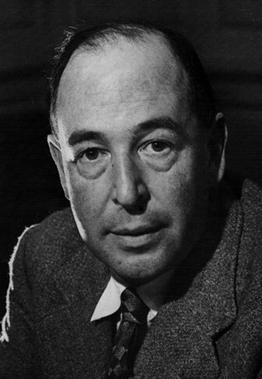
C. S. Lewis. From Wikipedia
I recently wrote in my blog in spanish (El Chapín Escéptico) about the stupidity of creationism against evolutionism. I expected a lot of hate mail which (unfortunately?) did not materialize. I did get a comment from a christian reader recommending me to read C.S. Lewis' Mere Christianity.
I did research the author and found this argument of his which does not make much sense to me. It is called "Lewis' Trilemma" although Lewis wasn't really the first to postulate it. It is often summarized as "Lunatic, Liar, Lord" and here is an early version:
"Christ either deceived mankind by conscious fraud, or He was Himself deluded and self-deceived, or He was Divine. There is no getting out of this trilemma. It is inexorable." ("Rabbi" John Duncan, 1796-1870).
The logical structure is as follows:
(P) Jesus claimed to be God
(Q) One of the following must be true:
Lunatic: Jesus was not God but believed he was
Liar: Jesus did not believe he was God but spoke as if he did
Lord: Jesus was God
(C) From these premises it is argued that: if Jesus was not God, he was either not great or not moral.
(Just for fun, a fourth L has been proposed, Legend, by, amongst others, my favorite bible geed, Bart Ehrman).
So far so good. Although it may be argued that there is a straw man or a false premise embedded in this argument (did Jesus really claim to be God? Did he exist at all?) the argument looks good so far.
What I utterly fail to see is where this proves that Jesus was divine, which seems to be Lewis' point. In his words:
"I am trying here to prevent anyone saying the really foolish thing that people often say about Him: I’m ready to accept Jesus as a great moral teacher, but I don’t accept his claim to be God. That is the one thing we must not say. A man who was merely a man and said the sort of things Jesus said would not be a great moral teacher. He would either be a lunatic — on the level with the man who says he is a poached egg — or else he would be the Devil of Hell. You must make your choice. Either this man was, and is, the Son of God, or else a madman or something worse. You can shut him up for a fool, you can spit at him and kill him as a demon or you can fall at his feet and call him Lord and God, but let us not come with any patronising nonsense about his being a great human teacher. He has not left that open to us. He did not intend to. ... Now it seems to me obvious that He was neither a lunatic nor a fiend: and consequently, however strange or terrifying or unlikely it may seem, I have to accept the view that He was and is God." (Lewis, C.S., Mere Christianity, London: Collins, 1952, p54-56).
There is a "leap of faith" that does not come from logic in this argument and there is not a shred of evidence. If this is the kind of apology for religion that I am being directed to read, I think I will be quite safe if I skip it and read Richard Dawkins' latest book instead!
Share on Facebook
Nacho Libre
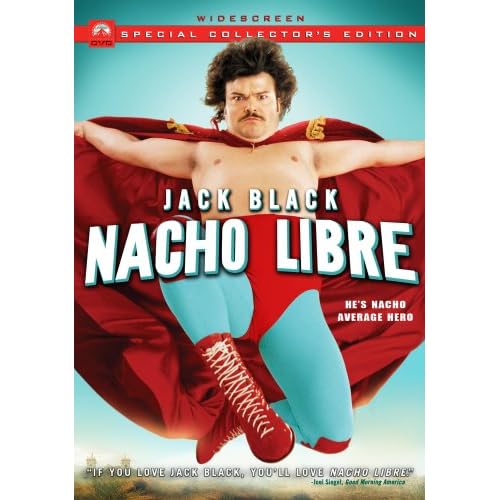
My friend Arc does movie reviews. He is the expert on this topic but I am taking a page from his book today to comment on Nacho Libre.
Nacho Libre is one of those movies you either have or love. Fans of Jack Black love it, others just despise it. Whatever the reason, if you like it because it made you laugh or hate it because of the slapstick comedic style, this movie will cause a reaction on you.
However, my reflection today deals with the prevalent mood of the movie. Nacho is a monk who has always been under the boot (or, rather, sandal) of the superiors in his monastery. Cruelty can be perceived in the lack of will of the monks and padres to improve the living conditions of the children (and monks and nuns) living under their care.
Nacho is the unlikely hero, the underdog, who through living his dream of becoming a luchador manages to bring some joy (and food) to the orphans, who prove to be his strong allies.
Nacho's love interest, the lovely nun played by Ana de la Reguera is another victim of this cruel system; she seems to be interested in a life outside of her little cell but is too afraid to try. In the end, Nacho does not get the girl which seems to have pissed everyone off (the viewers, of course) but just goes on to show the stronghold and fear the church can muster.
Fear of what I would ask? Nacho is always afraid his secret identity will be revealed and when it is discovered, he leaves before risking the consequences.
Nacho's sidekick, Esqueleto, is both providing the comic realief and the food for thought. When asked if he is a believer he responds "I only believe in science!"
Which is very ironic because obviously Esqueleto is uneducated. Which makes you wonder if the intention was to show how even uneducated, simple minds like Esqueleto's should reject the charade being played by organized religion. Nacho and sister Encarnación have no choice, they were indoctrinated from an early age but Esqueleto is a free agent and has a mind of his own.
As we all should have.
Share on Facebook
More reader comments: problems with the pope
Very often, people do not leave comments on my blog but rather post the comments to Facebook or e-mail them to me.
That is what happened a few days ago, when my posting trying to show what an ad-hominem fallacy was attracted the attention (and disagreement) of my FB friend Robert.
I find Robert's comments intriguing and engaging. His argument is that it may be impossible to separate the man from the ideas:
About the pope: "...He's led a campaign to maintain poverty in South America, spreads fatal diseases to millions by teaching them to have unprotected sex, and was one of the key people who arranged for paedophiles to be protected and witnesses (mostly raped children) to be intimidated into silence, which led to further child rape and the rapists themselves escaping justice. How can anyone /not/ have a problem with the pope?"
To which I (maybe naively) responded: "...I was discussing ad hominem fallacies so it is the ideas we have to go after... for all we know the guy's intentions may be good, as twisted as that may seem..."
Robert's reasoning was implacable. "By that logic we'd be letting Hitler and a whole bunch of other villains off the hook. It's not just the intention that matters, it's knowledge and awareness about what harm you are doing, as well as how you go about doing it. He opposed the anti-poverty campaign in South America because living in a wealthier environment would make them less ... Read More religious. Now it's well-known that being wealthy is no barrier to being religious, as America has shown, so instead of trying to guide them down that route he instead chose to keep them living in conditions that made them poorer, less healthy and unhappier. When it came to contraception in Africa, he could have told the truth about condoms and distributed them from churches, increasing attendence and saving lives at the same time. When a system-wide level of corruption was found in the church he could have led the charge to have them excommunicated and brought them to justice, placing the feelings of the innocent and justice above the church's power. However, in every instance where he could have done things differently that led to the church remaining strong and done a lot of good for the world he chose the option that led to an enormous amount of suffering, just so that the catholic church could get stronger. Because of his evil ways at least 4 continents have suffered, just for the sake of making the vatican more powerful."
I understand what he is talking about and tend to agree. Maybe we should be more careful of where we may place sympathies... I have indeed reflected on how pope Ratzinger, being such an erudite, must know the things I know about the bible and the history of the church and yet continues to preach strict adherence to catholic dogma... A true contradiction, in my book.
Share on Facebook
That is what happened a few days ago, when my posting trying to show what an ad-hominem fallacy was attracted the attention (and disagreement) of my FB friend Robert.
I find Robert's comments intriguing and engaging. His argument is that it may be impossible to separate the man from the ideas:
About the pope: "...He's led a campaign to maintain poverty in South America, spreads fatal diseases to millions by teaching them to have unprotected sex, and was one of the key people who arranged for paedophiles to be protected and witnesses (mostly raped children) to be intimidated into silence, which led to further child rape and the rapists themselves escaping justice. How can anyone /not/ have a problem with the pope?"
To which I (maybe naively) responded: "...I was discussing ad hominem fallacies so it is the ideas we have to go after... for all we know the guy's intentions may be good, as twisted as that may seem..."
Robert's reasoning was implacable. "By that logic we'd be letting Hitler and a whole bunch of other villains off the hook. It's not just the intention that matters, it's knowledge and awareness about what harm you are doing, as well as how you go about doing it. He opposed the anti-poverty campaign in South America because living in a wealthier environment would make them less ... Read More religious. Now it's well-known that being wealthy is no barrier to being religious, as America has shown, so instead of trying to guide them down that route he instead chose to keep them living in conditions that made them poorer, less healthy and unhappier. When it came to contraception in Africa, he could have told the truth about condoms and distributed them from churches, increasing attendence and saving lives at the same time. When a system-wide level of corruption was found in the church he could have led the charge to have them excommunicated and brought them to justice, placing the feelings of the innocent and justice above the church's power. However, in every instance where he could have done things differently that led to the church remaining strong and done a lot of good for the world he chose the option that led to an enormous amount of suffering, just so that the catholic church could get stronger. Because of his evil ways at least 4 continents have suffered, just for the sake of making the vatican more powerful."
I understand what he is talking about and tend to agree. Maybe we should be more careful of where we may place sympathies... I have indeed reflected on how pope Ratzinger, being such an erudite, must know the things I know about the bible and the history of the church and yet continues to preach strict adherence to catholic dogma... A true contradiction, in my book.
Share on Facebook
Subscribe to:
Posts (Atom)


